

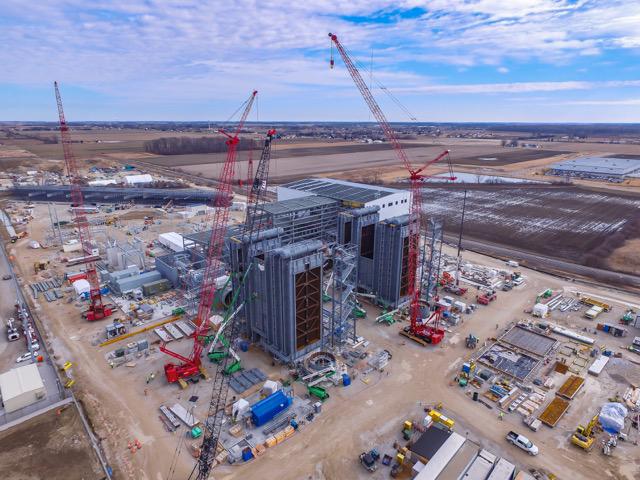
A power plant under construction in Ohio … not in New England. Source: Columbia Business First
It’s a question we get often: Why aren’t we seeing construction of new power plants in New England? Obviously, the logic goes, there’s a need for more generation: ISO New England is forecasting steady increases in electricity demand over the next decade, and that demand will increase at a much steeper pace if a significant data center – or a few data centers – finally come. The system is tight, plants have been retiring, and expected new generation (particularly offshore wind) has not come online at the pace or scale long expected.
So, what gives?
The simple answer: Power generation facilities have been receiving mixed signals about building around here. Everyone knows they need power generation, but both state and federal officials have been fickle about where it should come from. Where there’s uncertainty, there’s risk. When hundreds of millions of dollars – or, more often, billions of dollars – are at stake, that risk is too great.
We are in an unsatisfying and uncomfortable place right now in New England. NEPGA Members are in the business of building and operating power plants, and they do it well. In fact, they have been investing billions in energy infrastructure across the country, from Maryland and Pennsylvania to South Dakota and Hawaii. But here in New England, they have been caught between sometimes conflicting state and federal policies at the same time they are confronting prices in the wholesale markets that have yet to clearly say, “Go build.”
This situation has been developing for years.
How did we get here?
First off, there hasn’t been a “build” signal in New England’s markets for a while. To be sure, when there is, generators have stepped up. When the markets called for it, we saw approximately 9,500 MW of new facilities built in New England. That building boom helped offset more than 7,000 MW of retirements. These investment and retirement decisions were almost entirely a result of the price signals that were sent through the wholesale electricity markets.
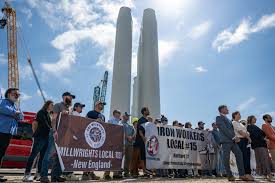
Workers and officials at the State Pier in New London, CT in Aug. 25, 2025, to discuss the Trump administration’s order to halt construction on Revolution Wind. Source: Maine Public Radio
But about 10 years ago, several states became much more prescriptive about the type of investments they wanted to see in electricity, whether the markets were supporting those technologies or not.
Most New England states mandated power contracts with offshore wind farms – nearly 10,000 MW worth – and increased imports from Quebec. The states also invested many billions in energy efficiency and distributed energy to reduce the need for additional infrastructure and passed legally-binding goals to reduce carbon across the economy. Taken together, New England’s public policy discouraged investments in new market-based dispatchable plants and prompted concerns whether an existing facility in a highly risky market will continue to operate long enough for its owners to recoup major investments in improvements.
For more than a decade, the message to generators was clear: If New England needed new power, New England policymakers — not markets — would pick the source. The construction of nearly 1,500 MW of offshore wind in the region is the fruition of those state efforts. Everyone else (i.e., the existing, non-preferred resources) would depend on the wholesale electricity market to survive. And “Everyone else” didn’t just mean fossil-fuel facilities, but existing clean energy sources, such as onshore wind, hydropower, and some of the region’s nuclear capacity.
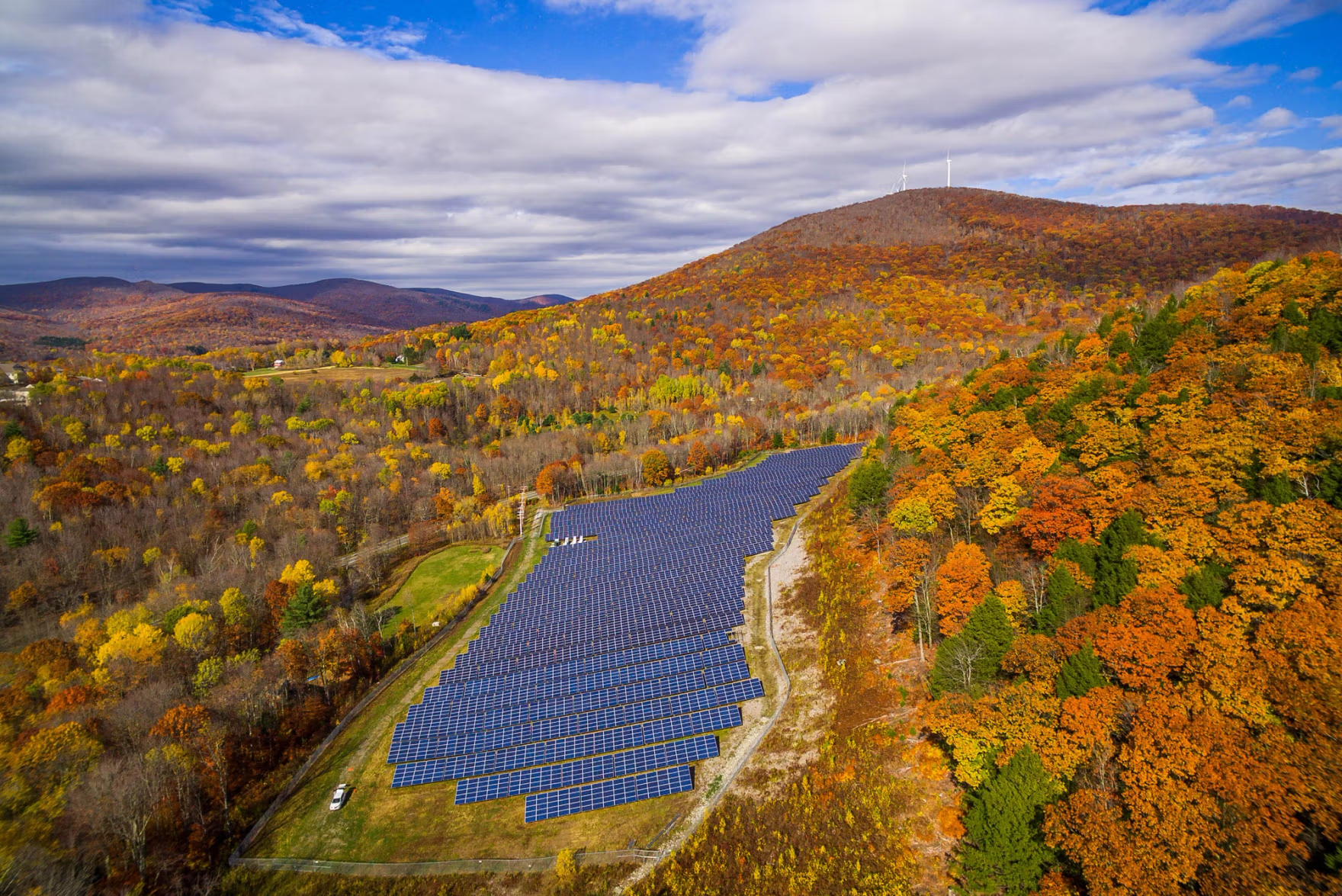
New England solar and foliage. Source: Nexamp
The times are changing, though. The big bets the New England states made on clean energy are not showing up today at the scale that was expected, and there’s no easy solution – political or economic.
Economic pressures, such as inflation and supply-chain constraints, combined with federal hostility, have marooned offshore wind in the doldrums. Even with federal support, the ongoing uncertainty, protracted permit timelines, and policy inconstancy will make offshore wind an enormously risky investment for years to come. This is coupled with a recognition of the limitations of the long-awaited deliveries of Canadian hydro.
This overall gridlock is hitting at a lousy time, when electricity demand has begun to tick up after 25 years of seeing declines. But even if demand weren’t increasing, New England’s electric grid is increasingly tight at times of severe weather, which is making energy prices ever-more volatile and drawing the attention of the public and policymakers.
So, the region is once again directing its attention to the competitive wholesale electricity markets, which are going through a big transition. New England is undertaking the biggest overhaul of its capacity market in 20 years and adding new ancillary service products. Of course, even when the markets ultimately send a “build” signal, other challenges need to be resolved.
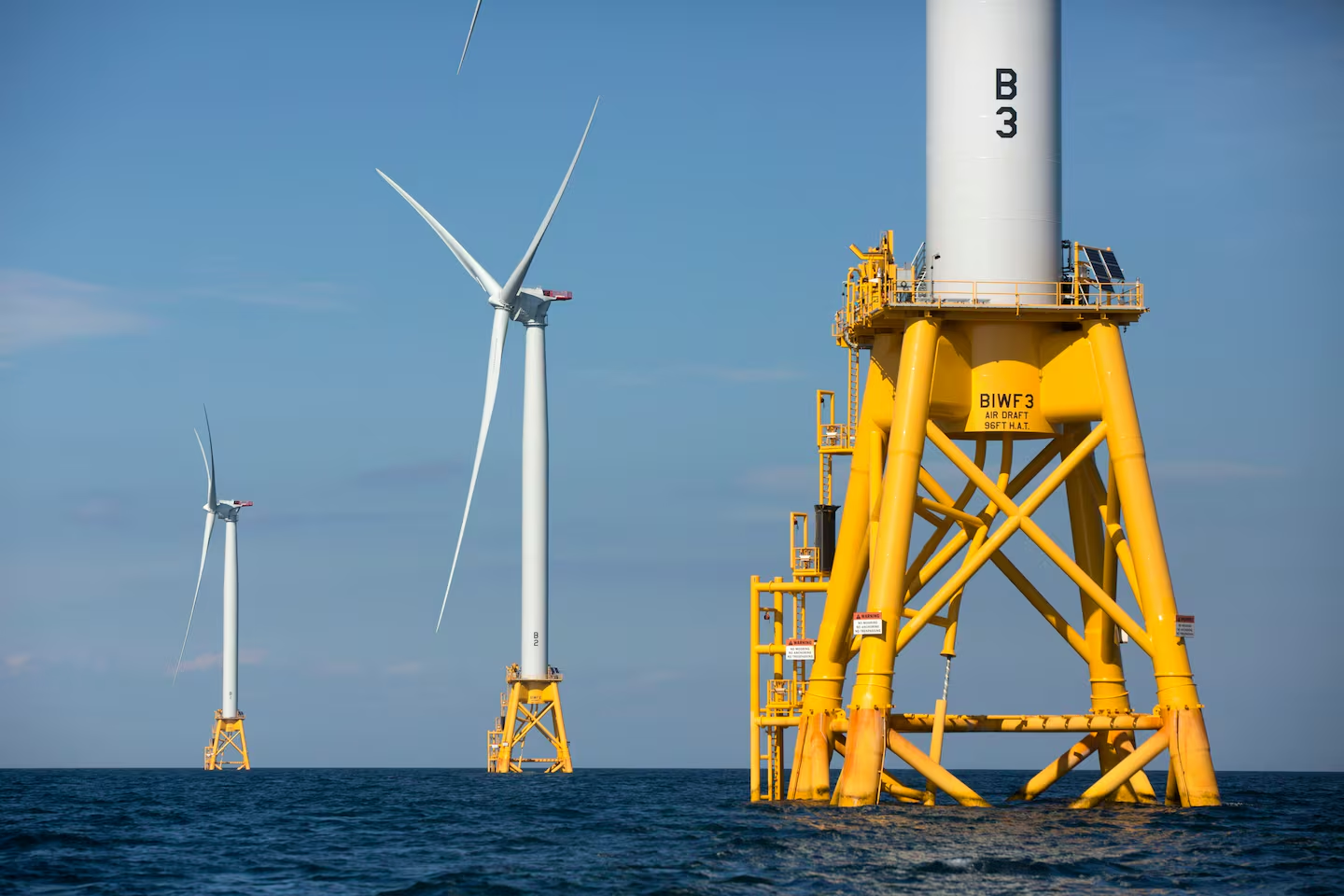
Block Island Wind, off the coast of Rhode Island. Source: The Boston Globe
The types of resources that current federal authorities support raise questions (generally) about New England’s state laws requiring carbon reductions. And even if the emissions-limits issues – and all they imply – were waived away with a magic wand, other issues remain in flux. New England is a fuel-supply constrained region. It is also densely-populated, known for challenging siting and permitting, and heavy on municipal involvement, which has yet to speed the pace of development.
What New England offers is uncertainty at every single level. If you’re a private company deciding whether to invest roughly $1 billion in permitting and construction in New England or some other part of the country – where demand is sharply increasing and officials welcome just about any type of power plant, not just a renewable one – that state wins over a project in New England. The reality is that billions of dollars are being invested by merchant generators around the country, in technologies including nuclear, natural gas, solar, storage, and virtual power plants in places including West Virginia, Illinois, Texas, and Arizona.
And so, when we are asked in New England, “Where are the next incremental megawatts going to come from?” the honest answer is, we don’t know. That is unsatisfying for the public, politicians, and, frankly, us.
It will require political leadership to clearly prioritize reliability investments to be dictated by the markets. It will require legislators to avoid the temptation to “just do something!” in the face of their voters’ anger and frustration. What seems harmless on paper — such as allowing utilities to build generation facilities (as is being discussed in both the New Hampshire House and Senate) or requiring the procurement of 20 GW of solar and offshore wind (which the Massachusetts legislature is hurtling towards)— simply amplifies the region’s “Don’t build here” message.
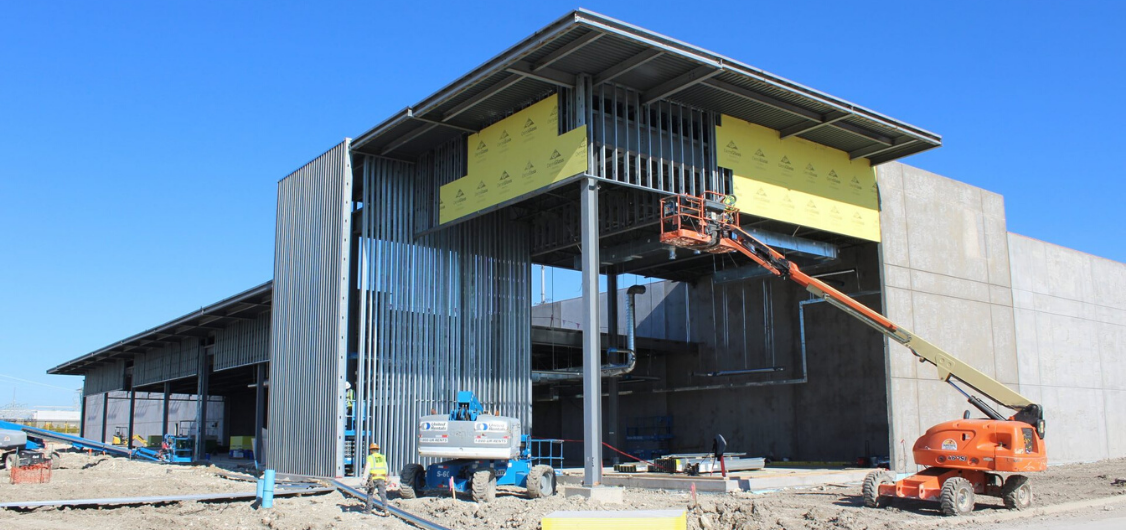
An under-construction data center. Source: Stream Data Centers
One thing is true, though: At a time of rising demand, New England simply cannot allow more of its existing facilities to retire without undermining reliability and affordability. That will require supporting reinvestment in the facilities that have kept the lights on through this coldest winter in a decade and last summer’s heat waves. Those plants will be needed for years. In fact, most of them will likely be needed for decades to come.
Clean energy investments will surely continue in New England, but there will be the need for flexibility in permitting and ongoing operations to balance this industry’s favorite metaphor – the three-legged stool of affordability, reliability, and clean.
New England, as a whole, needs to have reasonable conversations about what is feasible in the near-term (let’s call that the next 5-10 years) while continuing the hard work of meeting long-term goals and addressing our tight supply/demand conditions. None of this is easy.
The region’s power generators are committed to being a part of the solutions here. After all, we live here too.
In the meantime, at NEPGA, our immediate focus is on sound, reliable operations and our mid-term focus is on improving the market that drives crucial investments and, hopefully, helping policymakers blaze a trail that protects reliability, consumers, and the environment along the way.